

The holiday season is over. Thousands of Germans are returning from Italy, one of their favorite getaways and dream destinations. As well as sun, sea and soul food, the country’s outstanding achievements in art and culture are certainly part of its appeal.
The Italian Cultural Heritage Act
In May 2004, the Italian “Codice dei beni culturali e del paesaggio” entered into force, which translates to “Code of Cultural Heritage and Landscape” (hereafter “Cultural Heritage Act”). According to Article 107 of the Cultural Heritage Act, anyone wishing to commercially exploit a protected building or work of art must obtain prior authorization from the Italian institution in charge. In addition, Article 108 of the Cultural Heritage Act provides for the payment of a so-called license fee once permission has been granted. The underlying idea is to generate income to help preserve this cultural heritage.
Specifically, Articles 107 and 108 of the Cultural Heritage Act state:
Article 107
Practical and temporary use and reproduction of cultural heritage
1. The Ministry, the Regions and the other local authorities may authorize the reproduction and the practical and temporary use of the cultural heritage they have taken over, provided that paragraph 2 and the provisions on copyright are complied with. […]
Article 108
License fee, fee for reproductions, deposit
1. The license fees and charges in connection with the reproduction of cultural heritage shall be determined by the authority that has taken over the asset, taking into account
a) the type of activity for which the license is requested,
b) the means used for reproduction and the corresponding modalities,
c) the type and duration of use of the land and assets,
d) the use and purpose of the reproductions and the profit generated by the applicant.
2. Fees and charges are generally payable in advance.
3. No fee is due for reproductions requested or made by private individuals for personal use or study, or by public or private entities for valorization, provided they are not for profit. (…) In any case, the following activities are free if they are carried out for the purposes of study, research, freedom of expression, artistic expression or the promotion of knowledge of cultural heritage without the intention of profit: (…)
The fees due for the use of a piece of art are determined by the institution exhibiting the object on a case-by-case basis. If high revenues are expected, the fee will increase accordingly.
In the last two years, the following three cases in particular have caused a stir in Germany and beyond. Most recently, the German toy manufacturer “Ravensburger” has been working its way through Articles 107 et seq. of the Cultural Heritage Act.
Uffizi vs. Jean Paul Gaultier
In 2022, the Uffizi Gallery in Florence sued French luxury label Jean Paul Gaultier at the “Tribunale Ordinario di Firenze”, the civil court in Florence, as the owner of the rights to Sandro Botticelli’s famous painting “The Birth of Venus” (painted around 1485–1486). The dispute arose from the use of motifs from “The Birth of Venus” on garments that were part of Jean Paul Gaultier’s “Le Musée” fashion collection, which was promoted internationally (including in Italy) without prior permission from the Uffizi (see here):
In its lawsuit against Jean Paul Gaultier, the Uffizi not only demanded that the French couture brand cease all use of the items in question, but also demanded a recall, damages and the payment of a license fee. According to media reports, the latter was said to amount to more than €100,000. However, the case is still pending, and no ruling has been made. In particular, it remains to be seen whether the Maison Jean Paul Gaultier will be able to invoke the exception provided for in Article 108 (3) of the Cultural Heritage Act, according to which artistic use is free of charge. Is the “Le Musée” collection itself art?
Galleria dell’Accademia di Firenze vs. GQ
Within walking distance of the Uffizi Gallery, the Galleria dell’Accademia in Florence is home to arguably the most famous sculpture in the history of art: Michelangelo’s “David” (created around 1501–1504). His figure and his signature battle pose against the giant Goliath have been the subject of several lawsuits under the Cultural Heritage Act. The most prominent case is the dispute between the Galleria dell’Accademia di Firenze and Edizioni Condé Nast, which publishes the men’s magazine GQ in Italy. In a special edition of the July/August 2020 issue, the iconic “David” pose was reproduced on the cover of GQ using a so-called “lenticular print” of the model Peitro Boselli (see here):
Thanks to the ‘morphing’ effect of lenticular printing, the GQ cover showed either the iconic statue of David from 1500 or the face of the most famous male model of our time, depending on the reader’s perspective.
The Galleria dell’Accademia di Firenze won a judgment against Edizioni Condé Nast in 2023, once again before the Tribunale Ordinario di Firenze, on the basis of this magazine cover. Not only did the Galleria dell’Accademia di Firenze obtain an injunction against the use of the cover with the aforementioned “David” in Italy, but Condé Nast was also ordered to pay €20,000 in material damages and €30,000 in non-material damages to the Galleria dell’Accademia.
Galleria dell’Accademia di Venezia vs. Ravensburger
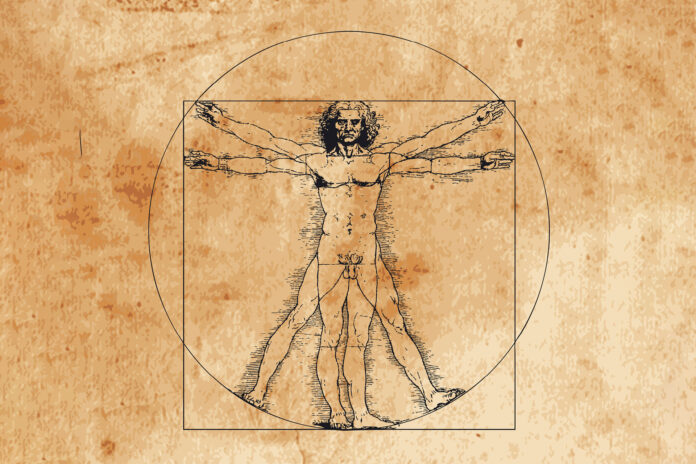
In the context of these cases, it comes as no surprise that in 2019 the Italian Ministry of Culture, together with the Galleria dell’Accademia di Venezia, took legal action against the German toy manufacturer Ravensburger. Specifically, the case concerned the sale of a jigsaw puzzle depicting Leonardo da Vinci’s famous “Vitruvian Man” (see here):
“The Vitruvian Man” (created around 1490) is very rarely shown to the public. It usually hangs in a climate-controlled vault in the Galleria dell’Accademia in Venice, which has owned it since 1822.
The case took a particularly curious turn, however, because the Ministry of Culture and the Galleria dell’Accademia di Venezia did not agree to a royalty that applied only to the territory of the Italian Republic. Both organizations were of the opinion that Article 108 of the Cultural Heritage Law applied worldwide, i.e., beyond the Italian borders. As no agreement could be reached, the Italian Ministry of Culture, together with the Galleria dell’Accademia di Venezia, applied to the Tribunale Ordinario di Venezia for an injunction prohibiting Ravensburger from commercially using images of the “Vitruvian Man” or parts thereof in any form and/or by any means on their products, websites and social platforms “in Italy and abroad”. While in the court of first instance, the Venetian Civil Court denied its local jurisdiction and therefore rejected the application for an injunction, in the subsequent appeal proceedings, it confirmed its jurisdiction and granted the injunction in accordance with the application in a judgment dated 24 October 2002.
Ravensburger, however, took the view that the two Italian bodies referred to above were not entitled to seek the injunctive relief sought under Art. 107 et seq. of the Cultural Heritage Act outside Italy. In addition, the relevant provisions of the Italian Cultural Heritage Act were contrary to EU law because they provided for copyright protection “ad infinitum”. Ravensburger therefore brought an action for negative declaratory judgment before Stuttgart Regional Court (Landgericht Stuttgart). Ravensburger sought a declaration that the Italian Ministry of Culture and the Galleria dell’Accademia di Venezia were not entitled to prohibit Ravensburger from using reproductions of Leonardo da Vinci’s “Vitruvian Man” for commercial purposes outside Italy, in whole or in part, in analog and digital form, on their products, their websites and in social media.
In its judgment of 14 March 2002 (Case No. 17 O 247/22), Stuttgart Regional Court allowed the action in its entirety. The question of whether the provisions of the Italian Cultural Heritage Act are contrary to European law insofar as they provide for a standard term of copyright protection for more than 70 years after the death of the author, derogating from Directive 2006/116/EC, could be left open. The court ruled that the provisions of the Cultural Heritage Act violate the principle of territoriality as a generally recognized principle of international constitutional law and thus the sovereignty of every state, including the Federal Republic of Germany. The ruling is not yet final.
Practical advice
Companies wishing to commercialize cultural heritage in any form should be aware that such commercialization needs to be carefully considered in advance. Although the Italian Cultural Heritage Act is unlikely to apply outside Italy, it is currently in force in Italy (whether or not it is contrary to European law) and may therefore make international marketing of products depicting Italian cultural heritage more difficult. However, the Italian Cultural Heritage Act is not the only law that may restrict the reproduction of cultural heritage for business purposes. In some cases, traditional names, such as “Münchner Oktoberfest”, are protected under trademark law by cities, states or state institutions. Famous paintings may be subject to a ban on reproduction – and thus exploitation – by museums exercising their domiciliary rights under civil law. Finally, there are international efforts to protect so-called “traditional cultural expressions”, i.e., cultural heritage, through international treaties. In May this year, a diplomatic conference was held at the World Intellectual Property Organization (WIPO) addressing this subject.
Overall, the Ravensburger ruling is just one piece of the puzzle when it comes to the use of high-profile cultural assets created by Da Vinci & Co.
Author
 Julia Bittner, LL.M.
df-mp Dörries Frank-Molnia & Pohlmann Patentanwälte
Rechtsanwälte PartGmbH, Munich
Attorney-at-Law, Senior Counsel
julia.bittner@df-mp.com
www.df-mp.com