Digitization, AI, and growth: The operational blind spot
The complexity of commercial law firms has been accelerating for years. Rapid advances in AI, changing client demands, regulatory pressures, and intense competition for talent can no longer be managed in isolation. Yet many partnerships still treat operational challenges as disconnected issues. AI currently dominates discussions: Substantial investments are being made, accompanied by high uncertainty and the question of when these technologies will yield a measurable ROI.
The answer rarely lies in the software itself. Digital tools only unlock value when organizational processes, decision-making rights, and accountabilities are fully aligned. AI cannot fix flawed workflows; it merely scales existing operational strengths and weaknesses alike. Digitizing dysfunctional processes simply yields automated dysfunction at a high cost.
The AI debate thus acts as a litmus test for overall organizational maturity. It reveals whether a law firm can collaborate effectively across practice groups and translate strategic vision into executed reality. Legacy structures, functional silos, and ambiguous leadership responsibilities impair firm performance far more than any technological solution can remedy.
This raises a fundamental leadership question: Who takes cross-functional responsibility for ensuring that investments in technology, human capital, and infrastructure produce tangible results? Can fee-earning managing partners absorb broad operational management, or does a modern firm require a dedicated executive to integrate strategy, processes, and people across disciplines?
Dual relevance: Why operational maturity matters to partners and general counsel
For law firm leaders and partners, establishing an effective C-suite management framework is an internal necessity – freeing up billable time, eliminating administrative friction, and safeguarding profitability. Yet this internal operational maturity directly impacts external market positioning.
When general counsel (GCs) evaluate external panel counsel, service delivery and operational professionalism have become decisive selection criteria. Corporate clients operate within disciplined corporate environments; they expect their legal service providers to demonstrate equivalent organizational rigor. Transparent billing, seamless client onboarding, robust data security, and efficient project execution are direct outcomes of professionally-managed business services. For GCs, a law firm with a strong COO signals operational stability, consistent quality, and an ability to deliver complex legal work predictably and cost-effectively.
The integrator function: Legal mindsets vs. executive leadership
In standard corporate environments, operational governance is straightforward: The CEO sets strategic direction, while executive management translates it into operational execution. Law firms present a far more intricate environment, where leadership operates at the intersection of equity partners, elected firm leaders, and fee-earning legal practices.
Lawyers are trained to analyze risks exhaustively, work autonomously, and maintain granular control over their cases. While essential for legal advice, management relies on delegation and orchestration – coordinating expert teams without attempting to perform every specialized task directly.
Managing partners are typically elected based on legal excellence, matter origination, and peer trust. Managing complex, cross-functional organizations naturally falls outside traditional legal training.
To bridge this gap, the Chief Operating Officer (COO) role has evolved into a strategic integration function. As one senior COO observed: “Alongside the Managing Partner, I am the person who keeps the entire system in view. While managing partners rotate, I provide operational continuity.” The COO’s mandate is not to manage every administrative detail, but to orchestrate the entire organizational machinery.
From back-office to C-suite
As commercial law firms grew in scale, specialized business services units emerged in Finance, HR, IT, and Business Development. Driven by growth and digital transformation, isolated administrative support evolved into professionalized business services requiring executive leadership: the modern COO.
Significant regional differences persist, however. Modern C-suite governance first matured in the US and UK legal markets. In Germany and continental Europe, partnerships relied on traditional partner-led administrative structures much longer, embracing dedicated C-level operational roles only in more recent years.
Four COO archetypes: Matching the mandate to firm strategy
Interviews with law firm leaders and executive recruiters reveal that the title “COO” encompasses widely varying mandates. “Pretty much every role is different,” says Tim Skipper, Director of Totum Partners. The primary differences lie in authority and scope, structured across two dimensions (fig. 1): Focus of activity (operational vs. strategic) and scope of responsibility (focused vs. generalist).
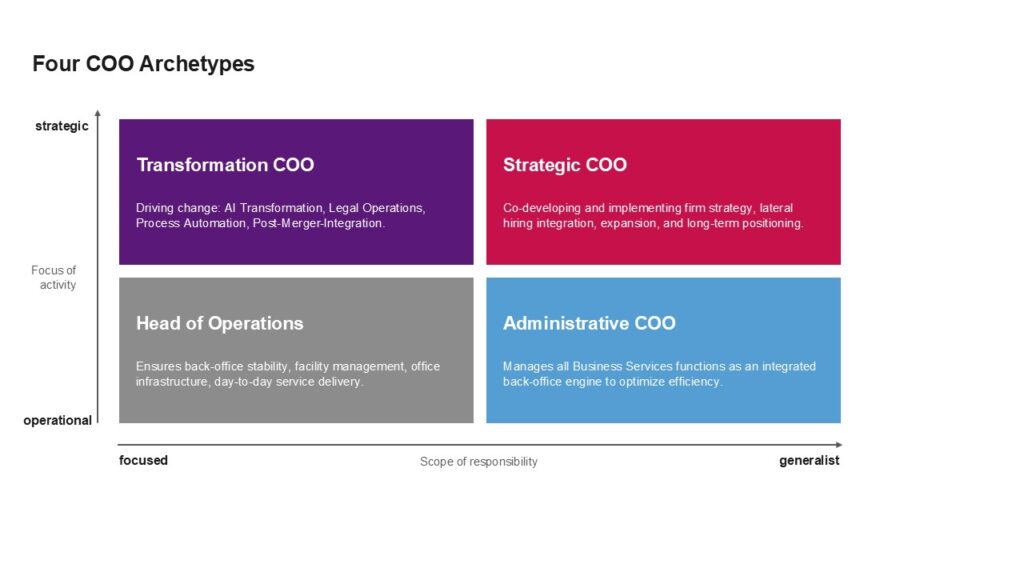
- Head of Operations (Operational/Focused): Focuses on back-office stability, facility management, and day-to-day service delivery.
- Administrative COO (Operational/Generalist): Manages all business services functions as an integrated commercial engine to optimize scalability.
- Transformation COO (Strategic/Focused): Drives structural change such as AI implementation, legal operations, and process automation.
- Strategic COO (Strategic/Generalist): Acts as a true peer to the Managing Partner, co-developing strategy, lateral hiring integration, and firm expansion.
One common pitfall occurs when partnerships hire a candidate before defining the strategic mandate. Despite their differences, successful COOs are integrating forces – “the spider in the web,” or the conductor of an orchestra where the partnership writes the score and the COO ensures harmony.
Flexible executive leadership: The rise of interim and fractional COOs
Law firms increasingly deploy agile leadership models to drive operational evolution:
- Interim COO: A full-time, temporary executive guiding firms through critical transitions, post-merger integrations, or leadership vacancies.
- Fractional COO: A senior executive providing ongoing strategic direction on a part-time retainer (e.g., 2–3 days per week).
“We see a strong appetite for interim and fractional management roles in the legal sector,” says Becky Mackarel, Partner and Head of the Investment & Professional Services Practice at Odgers Interim. Flexible solutions offer an effective way to professionalize management and drive change with agility.
What partners must do to enable the COO
A COO role cannot succeed in a vacuum. To enable true effectiveness, leadership must address three prerequisites:
- Explicit delegation & mandate: Clear, delegated decision-making authority to prevent partner micromanagement.
- The Managing Partner & COO tandem: A visibly unified leadership team to establish standing within a partner-owned structure.
- An investment mindset: Treating the COO not as an overhead expense but as a driving force for achieving strategic goals – one who frees up partners to boost revenue.
“The crucial question is whether partners are willing to give up some of their autonomy to ensure success for their business,” says Ori Wiener, Chair of PSFI.
The first 100 days: A strategic roadmap
Because authority in law firms is earned through credibility rather than formal hierarchy, a new COO’s first 100 days are decisive:
- Deep observation & cultural alignment: Invest early months in listening to partners and business services heads to understand informal power structures.
- Systematic partner interviews: Conduct structured discussions around three questions: What works well? What needs improvement? What do you expect from this role?
- Diplomatic quick wins: Resolve operational bottlenecks (e.g., onboarding delays, IT friction) without infringing on partner autonomy.
- Team formation: Align functional directors into a cohesive, service-oriented leadership team.
From COO to CEO: Strategic lessons from YPOG
To mirror corporate agility, forward-thinking firms are establishing a Chief Executive Officer (CEO) role – as seen at YPOG, which appointed Hariolf Wenzler, a non-lawyer, to lead firm strategy and operations.
This evolution offers distinct strategic advantages:
- External authority & credibility: A CEO title signals corporate rigor to corporate clients, venture capital funds, and enterprise GCs during commercial negotiations.
- Comprehensive process automation: Mapping and automating business processes elevates respect for business services while allowing legal partners to focus on core advisory work.
- Servant leadership: Modern executive leadership relies on collaboration. As Hariolf Wenzler articulates when asked whether he is the boss: “Nonsense – if we approach each other in mutual service and work together, we will be successful. Anyone who tries to act like the boss has already lost.”
Conclusion
Establishing professional C-level management is no longer a luxury – it is a critical driver of resilience, service delivery, and profitability. For managing partners, an empowered COO creates operational capacity to lead strategically. For general counsel, a firm’s operational maturity serves as a definitive indicator of service excellence, efficiency, and long-term value.