
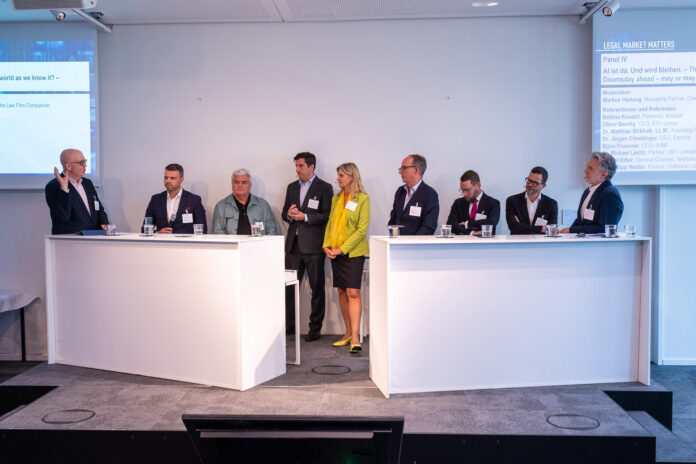
It was a successful inaugural event for the new cross-platform professional and networking event for the network partners of the Deutscher AnwaltSpiegel group and for selected guests at the new F.A.Z. Tower. Almost 150 participants registered for the event on 4 June 2024, which not only covered the current hot topics of the legal market but also celebrated the 15th anniversary of the online magazine Deutscher AnwaltSpiegel. The success story of this publication, from an innovative idea to an established institution, was a key theme in the welcoming address by Erwin Stickling, Member of the Management Board at F.A.Z. Business Media. He particularly highlighted the achievements of Prof. Dr. Thomas Wegerich, the initiator, publisher, and “heart, mind, and soul” of the vibrant network of decision-makers in corporate law. Wegerich, in turn, praised the team and long-standing advisory boards, as well as strategic and cooperation partners, whose commitment significantly contributes to reflecting the changes in the legal market in always up-to-date topics and event programs. However, this also includes its turbulences: the first issue of Deutscher AnwaltSpiegel featured a tax law guest article by a certain Hanno Berger, who was then a star among tax advisors. The rest is (legal) history. New challenges and the flood of regulations, orientation, and classification, as well as constructive dialogue between actors from companies, law firms, and legal service providers, are more important than ever, as co-organizer Dr. Daniel A. Pauly (Linklaters) emphasized. Karin Gangl, Head of Legal Publications at F.A.Z. Business Media, pointed to planned expansions and innovations in the product portfolio, such as the one-stop-platform www.germanlaw-international.com and the cooperation with F.A.Z. PRO Einspruch of the Frankfurter Allgemeine Zeitung.
Digital transformation and digital responsibility
The fact that digitalization is dramatically changing not only the legal but especially the media industry was the topic of the first keynote of the conference. Dr. Reinhard Müller, editor for current affairs, state and law, and for F.A.Z. Einspruch of the Frankfurter Allgemeine Zeitung, presented the concept of the vertical, which is specifically aimed at readers interested in legal topics and issues. With curated and exclusive content and podcasts around the theme of law, F.A.Z. PRO Einspruch targets students and professionals in the legal field who are looking for a deeper and regularly updated information source for their professional activities.
The second keynote of the afternoon, titled “Corporate Digital Responsibility” (CDR), dealt with a “code of conduct” for a changing legal market. Prof. Dr. Florian Drinhausen, Partner at Ashurst, and Dr. Bernhard Waltl, Legal Department at BMW and Co-CEO of the Liquid Legal Institute – the latter connected via Teams for scheduling reasons – explained the necessity of AI governance to effectively address the challenges posed by the capabilities of generative AI. Although the recently adopted AI Act provides the legal framework, there is a lack of relevant case law. As a result, rules are needed that are not found in laws but must be defined by the companies themselves. Using the examples of the BMW Group or Google, the speakers demonstrated that CDR must be an integral part of corporate culture to define clear values, weigh up protected goods, and assess risks. While there are legitimate doubts about how to regulate something that is not fully understood, companies are also responsible for the consequences of the technology they use.
ESG & Sustainability between opportunity and risk
What law firms and legal departments need to address now to bring the much-vaunted issue of sustainability to the point provided the framework for the first panel of Legal Market Matters. On the law firm side, Dr. Ilka Heigl, Partner at Göhmann, Isabel Hexel, Partner at Oppenhoff, and Prof. Dr. Christoph Schalast, Managing Partner at Schalast & Partner, faced Eva Gardyan-Eisenlohr, Chief Compliance Officer at Olympus, and Dr. Martin Fischer, General Counsel EMEA at Celanese, as corporate representatives. Moderated by Dr. Annika Bleier, Head of ESG & Sustainability at GvW Graf von Westphalen, the participants discussed, among other things, whether ESG & Sustainability is more of a compliance, or an innovation and transformation issue. While it can initially be viewed as part of enterprise risk management and integrated into existing systems, there was consensus on the panel that ESG strategies must become part of the business strategy, as they are increasingly relevant to M&A transactions. Younger employees play a crucial role in promoting ESG initiatives within companies. Although the two representatives of international companies emphasized the culturally specific nature of awareness of sustainability, a cultural shift towards a stronger purpose character in companies and law firms was deemed necessary. Companies expect not only advice from law firms but also their own sense of responsibility and sustainable action.
Compliance update: whistleblowing, supply chains, internal investigations, and compliance management systems
As head of the new BWD Task Force “Compliance & Internal Investigations” (see also the current article in fourword 02/2024), Dr. Ulrich Wastl, Partner at Westpfahl Spilker Wastl from Munich, led the second high-profile panel. With Katja Giese, LL.M., Partner at KLIEMT.Arbeitsrecht, Kira Uebachs-Lohn, Partner at EY Forensic & Integrity Services, Dr. Kerstin Wilhelm, Partner and German Co-Head of Crisis Management & Compliance at Linklaters, Dr. Tobias Eggers, Partner at PARK Wirtschaftsstrafrecht, Dr. Ulrich Hagel, Compliance Executive at Alstom, and Dr. Martin Ströhmann, Partner at Heuking, the discussion was conducted by recognized experts. Given the growing number of legal and regulatory requirements, the focus was on understanding compliance management systems as enablers that create the framework within which companies can operate safely. Data collection for validating and optimizing compliance processes was identified as a new trend that could gain importance in Europe as well. It is crucial to establish structures and processes to ensure compliance. One particular concern is the development of standards in the field of internal investigations, which still largely take place in a legal vacuum after the failure to implement the Corporate Sanctions Act.
From basement office to boardroom: cybersecurity as corporate culture
“No keynote, no panel without AI.” This is how Dr. Daniel A. Pauly, Partner and German Head of TMT & Global Co-Head of the Mobility Sector at Linklaters, ironically summed up his lecture. However, artificial intelligence has now also become an accelerant in terms of cybercrime, which is classified as the greatest threat to the economy with total losses of €200 billion per year. In his keynote, he provided an overview of the measures taken by the European legislator since last year, such as the Directive on the Resilience of Critical Entities, the NIS2 Directive, and the Digital Operational Resilience Act, which must be transposed into national law (see also the AnwaltSpiegel special on cybersecurity). Although this means an increase in bureaucracy once again, it is genuinely useful this time, unlike the excesses of the General Data Protection Regulation (GDPR). The fact that IT security has finally moved from the basement to boardroom offices, not least due to the looming liability for executive bodies, was also emphasized by the participants of the subsequent panel. Alongside Pauly, the two moderators Matthias Espeloer, Director of IT at Heuking, and Dominik Muissus, Chief Information Officer at Taylor Wessing, as well as Birgit Hess, Head of Global Success Delivery Center Cybersecurity & Compliance at SAP, took part. Using her own career as an example, Hess made it clear that cybersecurity – just like compliance and sustainability – requires a multidisciplinary and cultural approach to be anchored in the entire corporate culture.
Artificial intelligence in the legal industry – dawn or doom?
The final panel of the conference featured a remarkable nine discussants, which did not detract from its informational and entertainment value. Markus Hartung, Managing Partner at Chevalier Rechtsanwälte and The Law Firm Companion, guided the audience humorously and confidently through a serious topic that will change the business model and working methods of lawyers, companies, and service providers. The lawyers Bettina Knötzl, Partner at Knoetzl in Vienna, Dr. Matthias Birkholz, LL.M., Founding Partner at lindenpartners, Dr. Michael Leicht, Partner, TMT at Linklaters, and Dr. Philipp Wehler, Partner at Hoffmann Liebs, passionately debated with Oliver Bendig, CEO of the STP Group, Dr. Jürgen Erbeldinger, CEO at Escriba, and Björn Frommer, CEO at JUNE, as legal tech providers, as well as Marcel Ritter, General Counsel at Telefónica. Ritter clearly articulated the demand for the legislator to provide not just more regulation but concrete guidelines – also with the help of AI – to make legislation understandable and prevent bureaucracy. AI models already exist that can automatically create and analyze files from the moment they are received. These technologies could significantly support law firms in processing large volumes of text or conducting due diligence. While the final analysis and the derivation of the direction remain central tasks of lawyers, the efficiency gains often do not reach here. The more powerful the AI tools become, the more important it is for lawyers to have solid methodological training in using these technologies effectively. Although the future of the legal profession could already be shaped by software systems that communicate seamlessly with each other, AI does not “understand” contexts but merely links probabilities that need to be checked for plausibility. From legislation to the training of future lawyers, all stakeholders must work together to fully exploit the benefits of AI without compromising the quality and integrity of legal work.
BWD meets AnwaltSpiegel – wrap-up and outlook
At the end of the event, Thomas Wegerich picked up the thread again and emphasized – now in his role as deputy spokesperson of the Bundesverband der Wirtschaftskanzleien in Deutschland e.V. (BWD) – that all the topics of the Deutscher AnwaltSpiegel group are also topics of the BWD, which has now grown to include 50 renowned business law firms as members since its founding two years ago. Board spokesperson Stefan Rizor, LL.M. (McGill), took the opportunity to highlight current examples of how the association aims to facilitate the work of actors in legal-political Berlin. This includes the currently 19 task forces, whose position papers and events address both the topics of the coalition agreement and the wishes of the member law firms. With a view to the next generation, “heart, mind, persistence, and humor” will ensure that the business law firm of tomorrow has a future in a functioning legal state at a competitive location. Enough reasons to raise a glass after a successful event and toast the next 15 years of successful collaboration with a piece of birthday cake.
Author
Dr. Thomas R. Wolf
F.A.Z. Business Media GmbH, Frankfurt/Main
Editor Legal Publications