
As AI becomes embedded in enterprise workflows, legal and compliance leaders are stepping into a new role: Not just managing risk but shaping data strategy for the structure, controls, and accountability needed to responsibly adopt AI, including enterprise-wide tools such as Copilot for Microsoft 365.
A study conducted by the Information Security Media Group (ISMG) found that more than 80% of executives surveyed identified the risk of further data leaks as their primary concern when considering the adoption of generative AI within their organizations. This presents a major challenge that legal departments must also proactively address.
The promise and the pitfalls
AI offers a powerful new tool to streamline knowledge-worker tasks like marketing strategy creation, financial budget proposals, competitive analysis, and client service case summarization. However, the same capabilities that make AI so compelling also put sensitive data at risk of overexposure.
Prior to the widespread adoption of AI, data storage and access methods differed across companies and even functions. Users and even leadership often had limited understanding of what sensitive information was accessible and by whom, relying on a lack of awareness by larger employee populations to keep sensitive documents safe. Now, tools such as Microsoft Copilot can access and surface any data a user has permission to view. This can inadvertently reveal sensitive content (e.g., business strategy documents, privileged communications, or personally identifiable information (PII)) that was never meant to be widely shared.
There are three common scenarios observed in practice:
Negligent data use:
Users may inadvertently share sensitive information with public generative AI chatbots, and studies indicate that confidential data is frequently included in prompts. Once disclosed, this information can surface in future responses, potentially to unauthorized parties.
Negligent oversharing:
Users sometimes grant access to files and folders to broad groups, such as entire teams or the organization. Internal AI applications, including Copilot, may process and reference these files in responses, even if the requesting users are not permitted to access them under confidentiality policies.
Data leakage by disgruntled employees:
Oversharing can lead to situations where dissatisfied employees intentionally use generative AI to obtain and misuse confidential data.
Historically, access controls were designed for manual workflows. A user might have access to thousands of files, but without a search prompt or direct navigation, they’d never encounter most of them. AI changes that. It synthesizes and surfaces information from across the data estate, producing new content that puts sensitive details at risk. This shift demands an intentional and cautious approach to data governance.
Understanding your data estate
Before enabling AI, legal teams must take a hard look across their entire data landscape. This includes knowledge of where data is stored, awareness of access permissions, and the type of information that your organization qualifies as ‘sensitive’. Identifying criteria for sensitive information is a critical first step in limiting access permissions without leaving data vulnerable.
For instance, within Microsoft Cloud, there are several tools designed to detect outdated data, identify sensitive information in security-related artifacts, and monitor notable user activities, such as transferring sensitive data to external media.
This discovery phase is the foundation for AI implementation. Not just regarding compliance with privacy laws but also understanding what data must be retained for regulatory reasons, what should be defensibly deleted, and how strictly user permissions should be altered.
The quality of your organization’s data plays a significant role in producing effective results. The reality of leveraging AI to enhance workflows and productivity is that your results will look different when the quality of data is lacking. Many organizations spend years hoarding data, and the rise of AI is forcing a long-overdue assessment of data quality and retention.
Classifying and protecting
Not all data is created equal, and your security controls should reflect that. Highly sensitive content should be encrypted, tracked, and monitored. Less sensitive data may require lighter controls but should still be monitored.
This is where responsible AI experts and tools like Microsoft Purview come into play. By applying trainable classifiers and sensitivity labels, organizations can automate the identification and protection of critical data. Real-time Data Loss Prevention (DLP) and insider risk management tools then act on these classifications to block risky actions, warn users, or trigger alerts.
Educating and empowering
Even the best technical controls can’t prevent every mistake. User education and training are essential to ensure holistic compliance. Many professionals are not trained to properly leverage prompt engineering or the nuances of deploying AI. The results of one user’s well-crafted and specific prompt will vary widely from those of a new user vaguely prompting AI.
User training should focus on both the “how” and the “why”. Teach users how to write effective prompts but also help them understand the implications of AI content permissions. Train different functional teams separately using use cases that apply directly to their work. Lastly, remind users that AI isn’t a search engine; it is a collaborator that requires clear instructions and critical oversight.
Building a resilient framework
Organizations must accept that no responsible AI framework can be perfect. Any degree of content sharing can introduce risks, such as unintended exposure of sensitive data, and AI prompts and responses not working as intended. Sharing too much information can hinder implementation efforts and increase the likelihood of errors related to broad data access or prompt management. On the other hand, over-restrictive sharing schemas will grind collaboration to a halt.
A responsible AI framework acknowledges this and strikes the right balance based on the organization’s accepted risk appetite. To allow for collaboration while also mitigating the inherent associated risks, organizations should implement systematic procedures to address data overexposure, continuously monitor AI interactions, audit outputs, and improve access controls. Utilizing a “least permissive” access model, where users only have access to information relevant to their responsibilities, is highly encouraged.
Responsible AI adoption
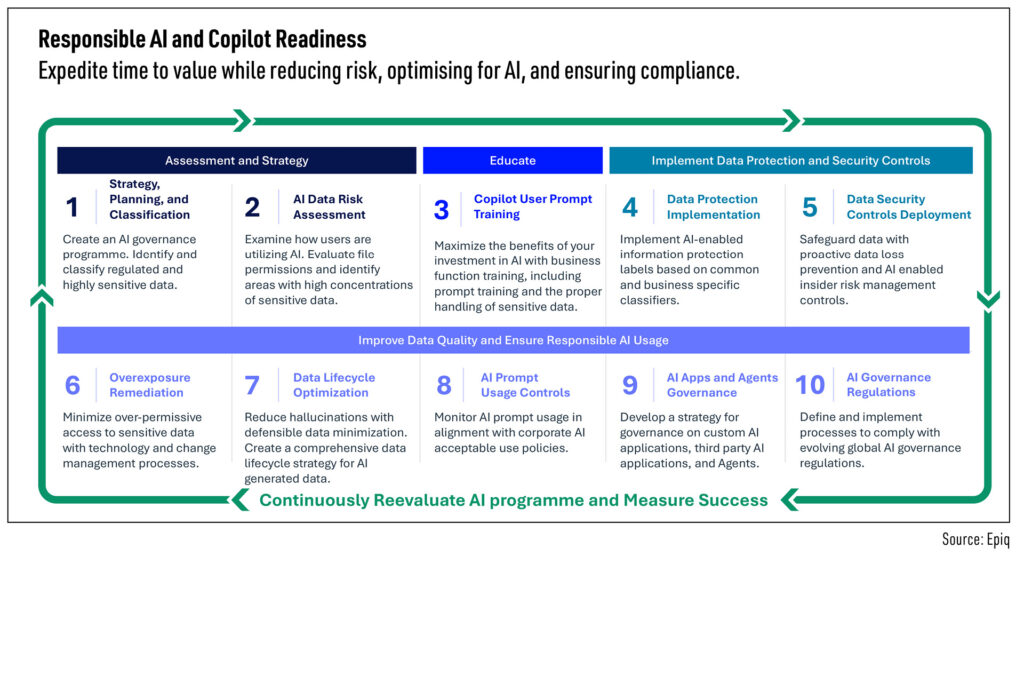
Eighteen months ago, Epiq launched its Responsible AI and Copilot Readiness offering, with a vision to empower organizations to harness the full potential of AI while maintaining the highest standards of data security and compliance. The offering includes ten steps, starting with an assessment, quickly getting copilot into the hands of its users by step three, and protecting long-term against data overexposure with steps four through ten (fig. 1).
Since then, legal teams have seen a surge in interest surrounding AI tools that boost broader organizational productivity, improve accuracy, and unlock new ways of working. As organizations race to adopt these technologies, one truth has become clear: Without a clearly defined data security strategy, the risks of overexposure of sensitive data are high.
Conclusion
AI has the potential to transform work, but only if it is implemented carefully and intentionally. By investing in data discovery, classification, user education, and proactive protection, organizations can unlock the benefits of AI without compromising security or compliance.