
I was in good company when I predicted that AI’s transforming power is going to be at least as significant as the internet’s: “If the internet changed the way we live and work, AI may have an even greater impact on our profession and our society. Not all of the consequences of AI have been identified yet, but it is clear the future is upon us,” wrote Almudena Arpón de Mendívil Aldama, IBA President 2023–2024, in her foreword to the IBA report The Future is Now.
How can we as lawyers – in law firms, in-house legal, or in public service – prepare ourselves for this future? What skills do we need to develop in addition to the skills we already have? What skill sets should we be looking for in recruiting decisions? We can use future skills frameworks as a source of inspiration and adapt them to our legal work. The result could look like this:
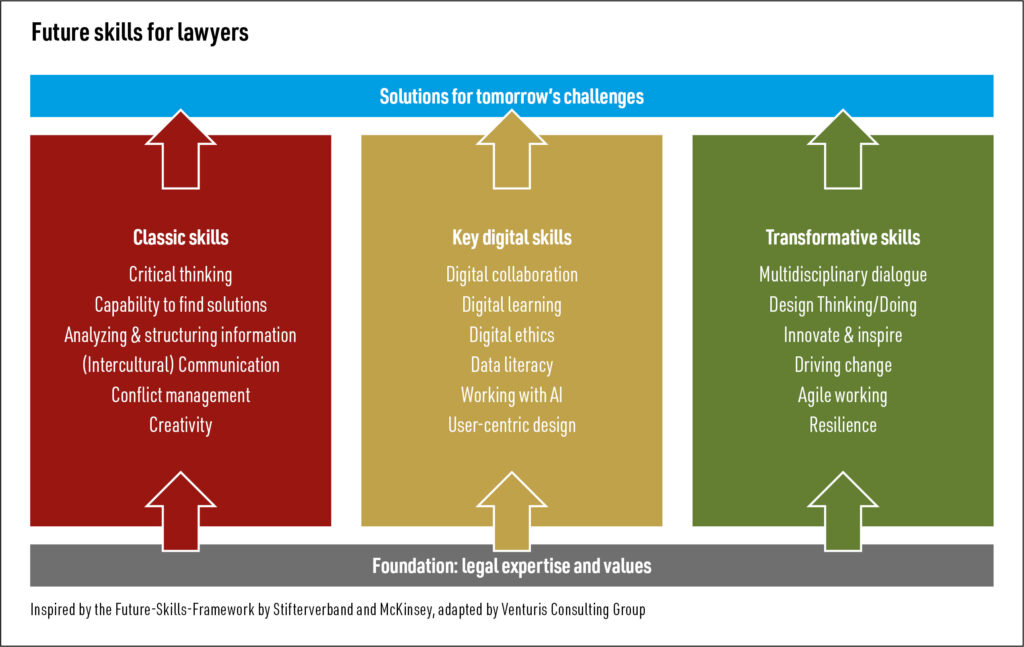
The broad foundation is still our legal expertise in various topics and our values (focus on clients’ best interests, confidentiality, handling conflicts of interests, etc.). Exactly how we are going to train young lawyers in legal expertise and values in the future is another matter, and something we should think about much more than we do today.
Our classic lawyer skills are more important than ever
The classic lawyer skills identified in the red section will, if anything, be even more relevant in the future. Lawyers’ inherent critical thinking and our trained abilities to analyze and structure information will be even more useful when we start working with AI. Our skills at resolving conflicts and in communication are in high demand in a VUCA world (volatile, uncertain, complex, ambiguous). Constant change and increased complexity in our environment (technological, geopolitical, climate-related, etc.) require creativity and the ability to find solutions. When it comes to these classic skills, we have a very good basis to stand on and can further hone those skills to tackle tomorrow’s challenges.
Key digital skills for lawyers and how to develop them
What is the state of lawyers’ digital skills? It seems that they are quite unevenly distributed. Some lawyers are well advanced in using digital tools for collaboration and learning, are actively looking for AI use cases, and/or understand how to read, understand, and use data for decision-making. Others are struggling with all of the above, and in particular with getting a handle on working with AI. Many lawyers have a really hard time taking the perspective of the users of their legal work products.
What can we do about this? Here are some suggestions:
- Digital collaboration: Try out one of the tools available for the legal industry or one of the many available generic ones.
- Digital learning: Find a topic that interests you on sites such as Coursera and take the course.
- Digital ethics: Discuss these with your colleagues or within lawyer organizations.
- Data literacy: Start with understanding the KPIs (key performance indicators) that drive your own organization and/or your clients.
- Working with AI: Get a Generative AI account and start experimenting. It’s mostly about learning by doing.
- User-centric design: Do some research into what this means. Learn how to create client personas. Map the client’s journey from first contact with you through the whole matter.
Transformative skills are rare and can be developed too
If key digital skills are unevenly distributed, transformative skills are very rare among lawyers. Collaboration and dialogue between lawyers and other experts often make the latter roll their eyes (we lawyers like to call them “non-lawyers”; thankfully and surprisingly, they have not returned the disfavor by calling us non-software engineers or the like). Very few lawyers have design skills, and legal design is still considered somewhat eccentric by many. Concepts such as innovation and change make many lawyers uncomfortable.
Research by Dr. Larry Richard has shown that 90% of lawyers score in the bottom half of the scale in resilience as a psychological trait. Low resilience people tend to be relatively thin-skinned and defensive. But research has also shown that we can learn to buffer the negative effects of change-induced stress through cognitive strategies that build resilience. These include realistic optimism, i.e., thinking about adverse events with a glass-half-full cognitive strategy. Another important factor to build lawyer resilience is creating a good climate at our workplaces where people feel safe to voice opinions, are appreciated for who they are, and where experimenting and good-intentioned failure is tolerated (these are the places where innovation happens).
The transformative skill set seems harder to acquire than key digital skills, but there is a methodology that helps develop several important transformative skills: design thinking, or design doing, as some prefer to call it. If I were asked for just one piece of advice, I would probably recommend every lawyer wanting to develop their future skills to attend a design workshop (in legal design or otherwise) where they get to actively participate in the design process. In just two to three days, you will gain so many insights that your head will spin. The experience will give you the transformative skills to innovate and inspire. There is even a considerable chance that you will have fun while learning.
You will, inter alia,
- understand the power of multidisciplinary groups with a variety of different expertise (and probably strike the term “non-lawyer” from your vocabulary),
- get to walk in the shoes of the people who have to understand and work with the products you deliver,
- develop professional empathy,
- be creative and innovative on a whole new level,
- learn to defer judgEditorment,
- work iteratively, and
- find the courage to put less-than-perfect ideas and prototypes out there to be tested and improved.
Add to this some of the suggestions above for deepening your key digital skills, in particular for working with AI, and your skill set will be future ready!